“Mom, what do you want us to do when you die?” is technically direct. It is also a good way to make everyone stare very hard at their dinner.
You do need the information eventually. You do not need to collect it all in one conversation.
When should you bring it up?
Earlier is easier. A routine conversation while everyone is healthy usually goes better than trying to learn a parent's wishes during a hospitalization or after a new diagnosis.
A natural opening can be something that happened to someone else, paperwork you are doing for yourself, or a practical question such as, “If you ever had to go to the hospital and couldn't speak for yourself, who would you want making decisions?”
Start with one question, not twenty
The National Institute on Aging recommends starting simply and keeping the conversation going over time. You might begin with:
- Who would you trust to make medical decisions for you?
- Do you already have an advance directive?
- Where is your will kept?
- Have you written down any funeral or burial preferences?
- Is there anything you especially do or do not want us to do?
If the answer opens a larger conversation, great. If it does not, you still learned something useful.
Do not make the conversation about taking control
Your parents are still the people making their own decisions. The point is to understand their wishes and know where important information is, not to take over accounts, paperwork, or medical choices before there is a need.
Language matters. “I want to make sure we know what you want” usually lands better than “We need to get your affairs in order.”
Ask about healthcare wishes
Find out whether they have an advance directive and healthcare proxy. If they are comfortable sharing, ask what matters most to them if they become seriously ill. Do they prioritize staying at home? Being able to communicate? Avoiding certain treatments? Religious or cultural practices?
A written directive helps, but a conversation gives the named decision-maker context when a situation does not fit neatly into a form.
Ask where the documents are, not necessarily what is in them
You do not need to know your parents' bank balances to know which institutions they use. You do not need to read the will to know where the signed original is stored.
At minimum, someone should know where to locate key legal papers, insurance information, financial records, healthcare documents, property information, and important contacts.
Talk about funeral and disposition preferences
Ask whether they have strong feelings about burial, cremation, donation, a green burial, or another legal option. Ask whether they want a religious service, celebration of life, private gathering, or something very simple.
If they say, “I don't care, do whatever you want,” that is worth writing down. It tells the family they are not violating a hidden wish.
Do not forget pets and the house
Who takes the dog? Where is the veterinarian's number? Is there a storage unit? Which neighbor has a key? Who services the furnace? These questions may sound almost comically ordinary next to wills and medical decisions, but they are exactly the questions adult children end up scrambling to answer.
What if your parent refuses to talk?
You cannot force someone to plan. Say why you are asking, keep the request small, and leave room to return to it later.
You might say, “You don't have to go through everything with me. I would just feel better knowing where the important papers are if there were ever an emergency.”
If they would rather talk with a doctor, attorney, clergy member, or another family member, that still moves the planning forward.
Should siblings be involved?
If your parents want them involved, yes, but avoid turning the discussion into a family committee where everyone votes on your parent's wishes. One person may ultimately be named as healthcare proxy or executor. The others can still understand the plan and know who has which role.
Clear roles now can reduce conflict later.
Write down what you learn
After the conversation, encourage your parent to record the decisions in the appropriate legal documents and in a practical planning file or binder. Memory gets unreliable when everyone is stressed.
Our end-of-life binder guide can help organize the non-legal information families often need.
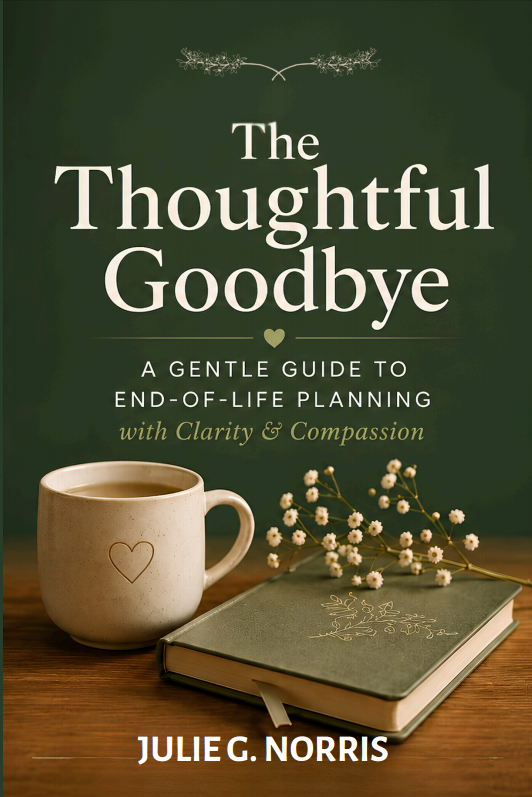
A book can make the conversation easier
The Thoughtful Goodbye gives families a practical way to work through decisions without trying to remember every question at once.
See what's inside the book →