Not everyone has a spouse, children, siblings, or relatives they trust. Some people are estranged from family. Some outlive the people closest to them. Some have a chosen family that matters far more than their biological one.
If that describes you, planning becomes more important, not less. Without your own instructions, state law and institutional procedures may decide who can act, who inherits, and what happens when nobody obvious is available.
Who makes medical decisions if you cannot?
If you have not named a healthcare proxy and you become unable to make decisions, state law may determine who can act. The National Institute on Aging notes that default decision-makers are often relatives, although the rules differ by state and some states have alternatives when family is unavailable.
If you want a trusted friend, partner, neighbor, or another person to speak for you, complete the appropriate healthcare power of attorney or advance-directive documents for your state and tell that person what you want.
Can a friend be your healthcare proxy?
Often, yes, subject to state requirements and certain restrictions. The important question is not whether the person shares your last name. It is whether they are legally eligible, willing to serve, able to stay calm under pressure, and understand your values.
Choose a backup if possible.
What happens to your property if you die without a will?
If you die without a valid will, state intestacy law determines who receives property that passes through probate. The American Bar Association explains that these laws generally favor a spouse and relatives. If no eligible heirs can be found, property may eventually pass to the state through a process called escheat.
If you want friends, charities, organizations, or other non-relatives to receive property, do not assume the default rules will accomplish that. Put a valid estate plan in place.
Who can be your executor?
You may be able to name a trusted friend, professional fiduciary, attorney, bank, or other qualified person or institution, depending on state law and the complexity of the estate. Ask before naming someone. Serving as executor can involve months of paperwork, deadlines, bills, taxes, property management, and communication with institutions.
If there is nobody in your personal life who should take the role, an estate-planning attorney can discuss professional options.
Who handles your funeral?
Authority over disposition and funeral arrangements is governed by state law. If there is no obvious family member, written planning can be especially important. Ask a local attorney or licensed funeral provider how your state allows you to document who should control arrangements and what wishes can be recorded in advance.
Write down whether you want burial, cremation, donation, green burial, or another legal option, and where your instructions are stored.
What happens to pets?
A pet does not become someone else's responsibility simply because you hoped it would. Choose a caregiver and backup caregiver, get their agreement, and document the animal's needs.
All 50 states and the District of Columbia have laws allowing pet trusts, according to the ASPCA, though the details vary. A pet trust or other estate-planning arrangement may be useful when there is no family member who would naturally step in.
Our pet-planning guide walks through the practical details.
Build a small team instead of looking for one person
You do not need one heroic friend to do everything. Your healthcare proxy, financial agent, executor, pet caregiver, emergency contact, and funeral contact can be different people.
Think in roles:
- Who knows your medical wishes?
- Who can handle money responsibly?
- Who can manage paperwork?
- Who would care for pets?
- Who should be called first in an emergency?
- Who knows where your records are?
What practical information should you leave?
If there is no close relative who already knows your life, documentation matters even more. Keep a clear record of accounts, insurance, doctors, prescriptions, property, keys, subscriptions, digital accounts, pets, important contacts, and final wishes.
Our end-of-life binder guide gives you a structure for that information.
What if you truly have nobody to name?
Start with professional advice rather than doing nothing. An estate-planning attorney can explain professional fiduciaries, trust companies, local public or private guardianship resources, charitable planning, and other options available in your state. A funeral provider can explain local pre-arrangement rules. Your healthcare system or local aging-services organization may also be able to point you toward advance-care planning resources.
The absence of close family does not mean you have no choices. It means those choices are less likely to happen automatically.
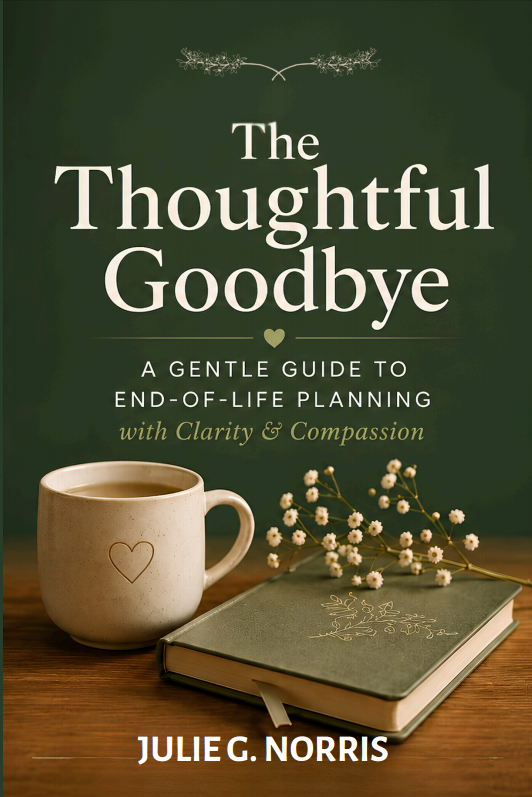
Planning when there is no obvious next of kin
The Thoughtful Goodbye includes practical guidance for people who do not have a traditional family structure or an obvious person to leave everything to.
See what's inside the book →